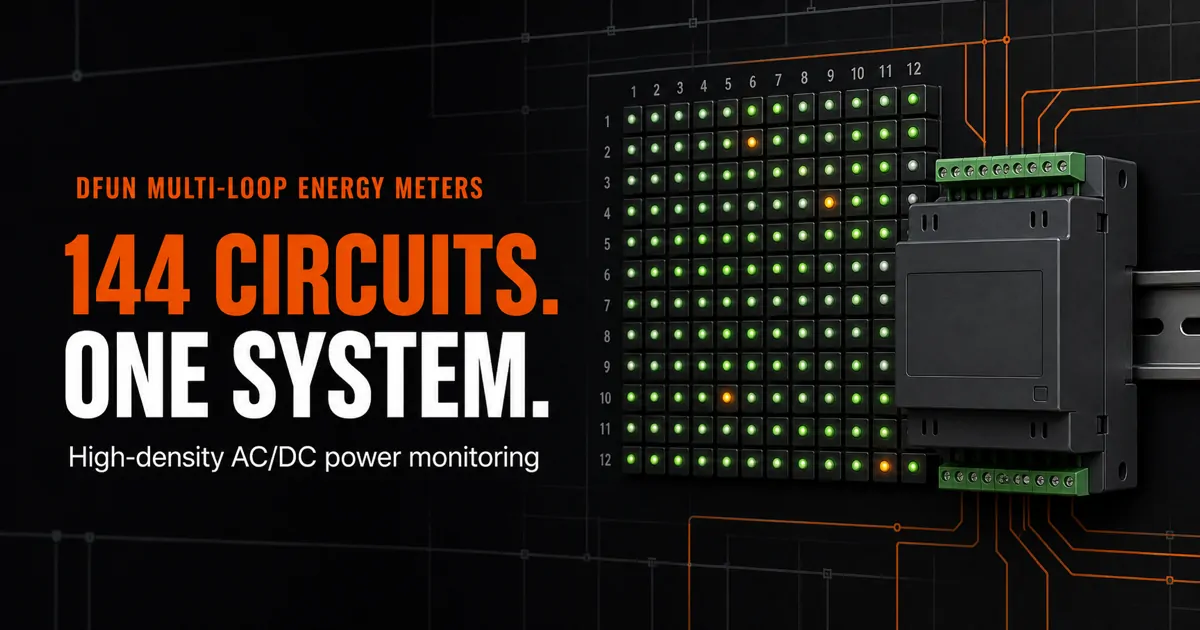
144 Circuits. One DFUN Multi-Loop Energy Meter System.
In a conventional one-meter-per-circuit design, monitoring 144 electrical circuits may require up to 144 individual meters. A DFUN multi-loop energy meter consolidates the same monitoring scope into one coordinated system consisting of a main controller, modular measurement units and current transformers.
The DFPM206 supports up to 144 AC branch-circuit monitoring channels, helping data centers and other high-density power systems simplify panel design, communications, commissioning and branch-level energy management.
What Is a Multi-Loop Energy Meter?
A multi-loop energy meter is a centralized electrical measurement system that monitors multiple incoming and branch circuits through one controller. Unlike a conventional meter that normally serves one circuit, a multi-loop system combines a controller, measurement modules and current sensors to collect circuit-level electrical data in one coordinated architecture.
DFUN offers dedicated multi-loop models for both AC and DC systems:
DFPM201: up to 12 DC circuits
DFPM211: up to 45 single-phase or 15 three-phase AC circuits
DFPM206: up to 144 AC branch circuits
This modular approach is particularly valuable when a project requires high circuit density, limited panel space, centralized communications and detailed branch-level visibility.
Traditional Energy Meters vs. DFUN Multi-Loop Metering
In a conventional one-meter-per-circuit system, 144 monitored circuits may require up to 144 individual meters. A DFUN multi-loop system uses a centralized controller and modular branch units to monitor the same circuit scale through one coordinated architecture.
| Comparison | Conventional meters | DFUN multi-loop system |
| Metering architecture | One standalone meter per circuit | Central controller with modular measurement units |
| units | ||
| 144-circuit project | Up to 144 individual meters | One DFPM206 system configuration |
| Panel design | Repeated meter cutouts or DIN-rail devices | Compact controller and measurement modules |
| Wiring | Power and communication wiring repeated for each meter | Centralized communication with modular expansion |
| Data management | Measurements distributed across many devices | Branch data organized within one system |
| Expansion | Add another complete meter | Add compatible 24- or 48-channel modules |
| Communications | Depends on every individual meter | Modbus RTU and Modbus TCP on DFPM206 |
| Harmonic analysis | Model-dependent | Up to the 63rd order on DFPM206 |
| Maintenance | Many independent meter devices and addresses | Coordinated system architecture |
| Communications | Depends on every individual meter | Modbus RTU and Modbus TCP on DFPM206 |
| Harmonic analysis | Model-dependent | Up to the 63rd order on DFPM206 |
| Maintenance | Many independent meter devices and addresses | Coordinated system architecture |
Summary: DFUN does not simply make a smaller conventional meter. It replaces a distributed one-meter-per-circuit architecture with a modular multi-circuit monitoring system.
Which DFUN Multi-Loop Energy Meter Is Right for Your Project?
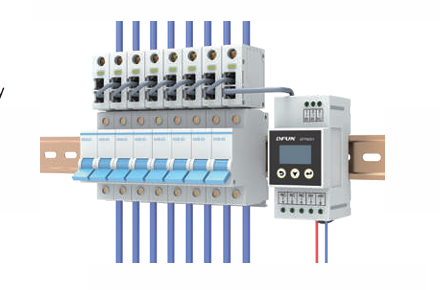
DFPM201 Multi-Channel DC Energy Meter
DFPM201 is designed for -48 VDC applications such as telecom site billing systems and DC load management.
Key specifications
Supports up to 12 single-phase DC circuits
Voltage and current accuracy: Class 0.5S
Energy accuracy: Class 1.0
RS485 communication
Modbus RTU protocol
Modular main controller and measurement modules
Best suited for
Telecom sites
-48 VDC distribution
DC load monitoring
Branch-level DC energy measurement
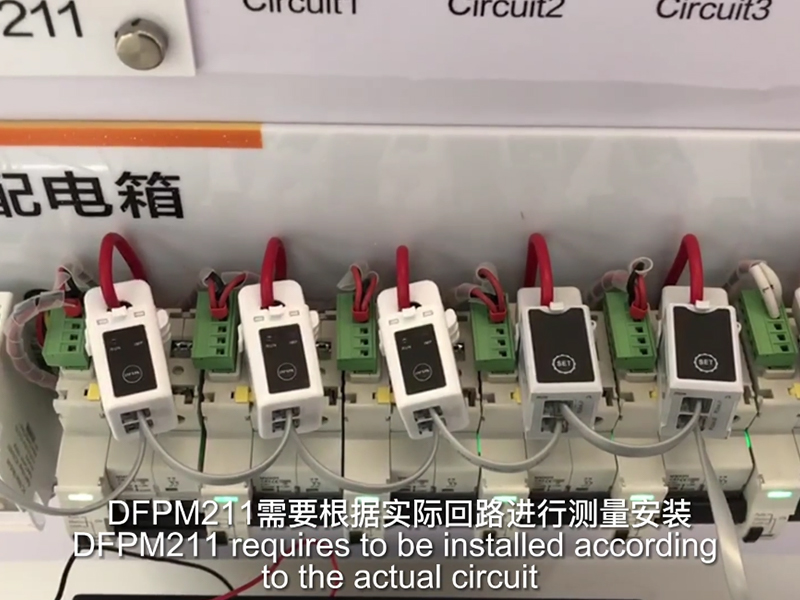
DFPM211 Multi-Channel AC Energy Meter
DFPM211 is a compact modular AC metering system for telecom energy management, data centers and other multi-circuit AC applications.
Key specifications
Supports up to 45 single-phase circuits
Supports up to 15 three-phase circuits
Voltage and current accuracy: Class 0.5S
Energy accuracy: Class 1.0
RS485 communication
Modbus RTU protocol
Documented installation benefits
Saves 50% installation space
Saves 50% installation hours
Saves 50% system debugging time
Best suited for
Medium-density AC distribution
Telecom facilities
Commercial energy management
Data-center auxiliary distribution
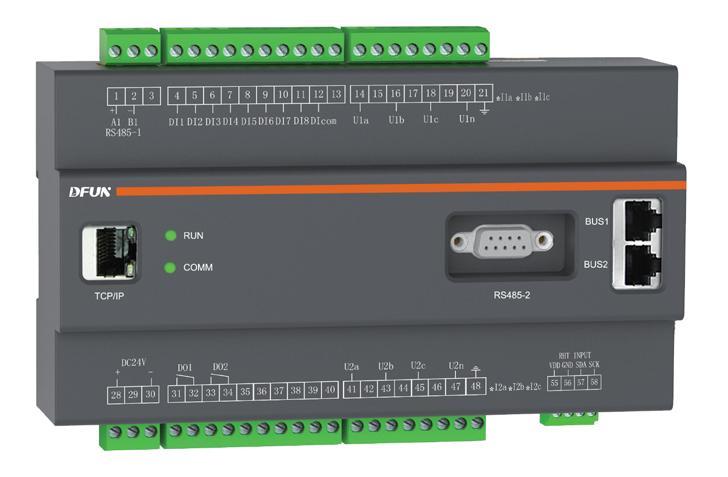
DFPM206 Multi-Channel AC Energy Meter
DFPM206 is designed for data centers and server rooms that require high-density endpoint energy data collection and real-time power-distribution monitoring.
Key specifications
One or two incoming lines
Maximum 144-channel branch output monitoring
24- or 48-channel branch monitoring modules
Branch CT options: 50 A or 100 A
Clamp-on or split-core CT options
Optional neutral and leakage-current monitoring
Voltage and current harmonic analysis up to the 63rd order
Eight digital inputs and two digital outputs
One RJ45 and two RS485 communication interfaces
Modbus RTU and Modbus TCP
Optional touchscreen HMI
More than 5,000 event records
Historical event query and fault diagnosis
DIN-rail installation
Measurement accuracy
Voltage and current: ±0.5%
Power and energy: ±1%
Frequency: ±0.02 Hz
Best suited for
Data centers
Server rooms
High-density branch circuit monitoring
Critical power-distribution panels
Endpoint energy management
How Does the DFPM206 144-Circuit System Work?
A DFPM206 system is built in four coordinated layers:
1. Branch current transformers
Current transformers measure individual outgoing circuits. DFPM206 supports 50 A and 100 A branch CT options in clamp-on or split-core configurations.
2. Branch monitoring modules
DFPM206 branch units monitor 24 or 48 single-phase circuits. Multiple modules can be combined to scale the system to a maximum of 144 branch channels.
3. Main controller
The DFPM206 main controller monitors one or two incoming lines, organizes branch data and provides communication with the upstream monitoring platform.
4. Central monitoring platform
The controller connects to a power monitoring, data-center infrastructure management, building management or energy management platform through Modbus TCP or Modbus RTU.
The result is one coordinated monitoring architecture from the current sensor to the management platform.

Data Centers
Monitor high-density branch circuits, incoming feeds and server-room power distribution. DFPM206 helps operators compare loads, identify abnormal circuits and integrate branch-level data with a centralized monitoring platform.
Telecom Sites
Use DFPM201 for -48 VDC loads or DFPM211 for AC distribution. Both models support centralized multi-circuit measurement in space-constrained telecom environments.
Industrial Facilities
Centralize load and energy monitoring across multi-circuit power panels. Use branch-level measurements to support capacity planning, maintenance and energy analysis.
Commercial Buildings
Monitor tenants, floors, equipment groups or functional areas without installing a separate complete meter for every monitored circuit.
Critical Power Systems
Track incoming and outgoing circuits in systems where uptime, alarm visibility and centralized data access are operational priorities.

FAQ
Q1: What is the difference between a multi-loop energy meter and a conventional meter?
A: A conventional energy meter normally measures one circuit. A multi-loop energy meter uses one controller and modular measurement units to monitor multiple incoming and branch circuits within one coordinated system.
Q2: Can one DFUN system monitor 144 circuits?
Q3: Does “144 circuits, one system” mean one physical meter?
Q4: Which DFUN model supports DC circuits?
Q5: Which DFUN model supports 45 AC circuits?
Q6: Which communication protocols does DFPM206 support?
Q7: Can DFPM206 analyze harmonics?
Q8: Is DFPM206 suitable for data centers?
Q9: How do I get a DFUN multi-loop meter proposal?
Related Blogs
-
 DFUN's smart battery capacity testing solution integrates BMS monitoring and capacity verification. Learn the synergy between continuous monitoring and accurate capacity testing for critical power systems.Value Article
 -
 Railway battery monitoring system ensures reliable backup power for rail transit. Learn how DFUN BMS monitors voltage, internal resistance, temperature, SOC/SOH, with case studies from Thailand Skyline and Hong Kong MTR.Case Study
 -
 Internal resistance is one of the most reliable early indicators of VRLA battery health, but there's no single universal number that tells you when to replace a battery — the reading only means something against the cell's own baseline. This article breaks down the 50%-above-baseline replacement rule, the 20–30% cell-to-cell deviation check for spotting a lagging unit, and why a sudden jump in resistance matters more than a high absolute value. It also covers why resistance alone isn't enough — pairing it with float voltage checks, capacity discharge testing, and visual inspection — and how DFUN's integrated battery monitoring and capacity testing platform automates threshold tracking across an entire string.Case Study
 -
 Hospital backup batteries can degrade gradually and go unnoticed between manual inspections. This article explains the key maintenance challenges and how DFUN BMS's continuous per-battery and string-level monitoring — covering voltage, temperature, internal resistance, SOC and SOH — helps hospitals catch weak batteries early, illustrated with a real deployment case at a German hospital.Case Study


Get a DFUN Multi-Loop Metering Proposal
Send us your circuit count, single-line diagram and communication requirements. Our team will recommend the appropriate DFUN controller, measurement modules and current sensors.
Mob:+86-15919182362
E-mail:info@dfuntech.com